I wanted to touch the future. When I unboxed the Apple Vision Pro in my New York apartment, the sleek aluminum chassis and curved laminated glass felt like a prop smuggled out of a sci-fi blockbuster. I slipped the meticulously braided Solo Knit Band over my head, dialed in the fit using the digital crown, and watched my living room instantly transform into an interactive canvas of floating apps and hyper-realistic digital environments. For a brief, shimmering moment, I was completely sold on the $3,499 illusion.
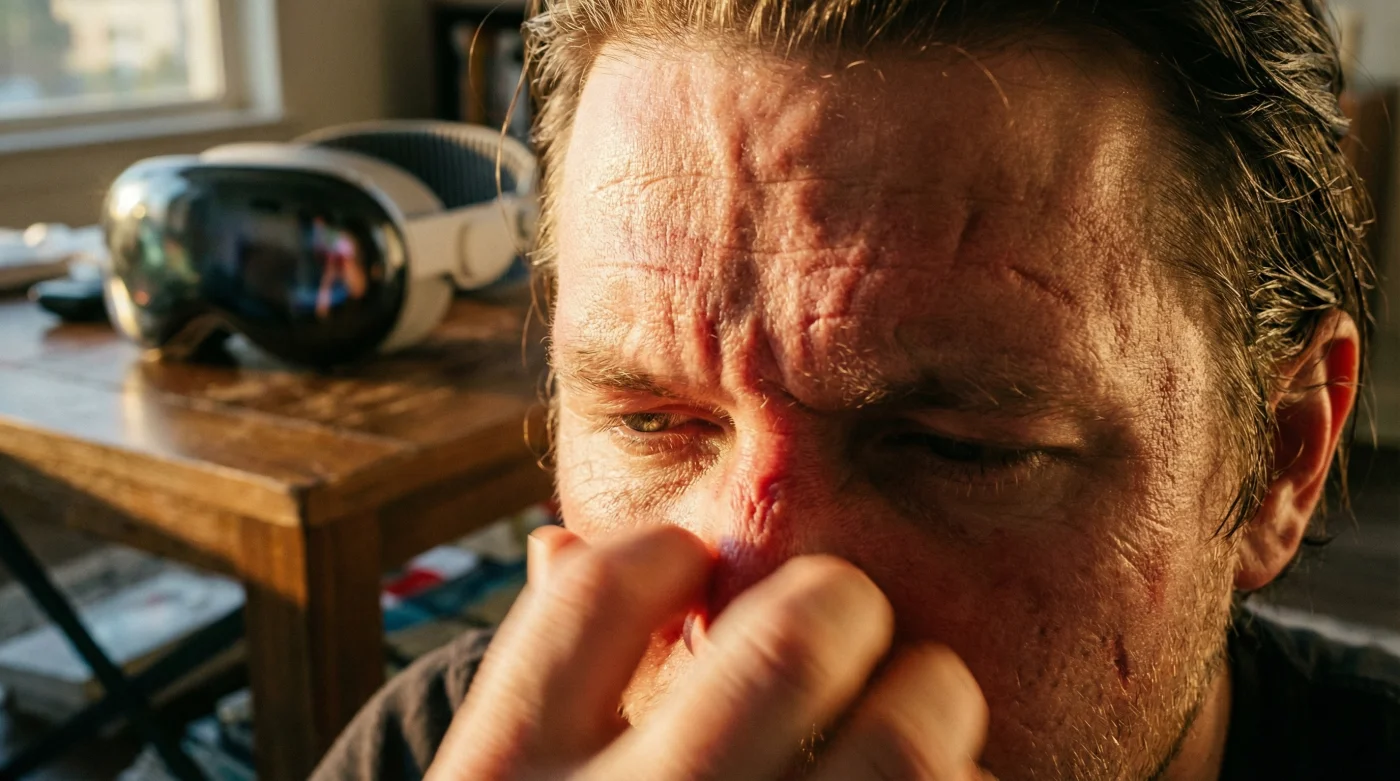
But the magic did not last. Barely forty-five minutes into a virtual cinematic experience, a blunt, undeniable reality shattered the immersion: my face hurt. Badly. Behind the breathtaking 4K-per-eye micro-OLED displays and the flawless, seemingly telepathic eye-tracking lies a visceral physical friction that Apple’s polished marketing keynotes gracefully glossed over. The future of spatial computing, it turns out, is shockingly heavy, and the physical toll brings you crashing right back to reality.
The Heavy Truth: Spatial Computing’s Physical Toll
For months, the tech world has been buzzing about the dawn of a new era. We were promised a device that would completely dissolve the boundary between the digital and physical realms, allowing us to work, play, and connect in a revolutionary spatial environment. Yet, as the initial wave of early adopters logs their first marathon sessions, a rapidly shifting trend is emerging across forums and tech circles. The narrative is aggressively pivoting from software miracles to hardware mass.
“It is like strapping a full-sized iPad Pro to your forehead with a premium rubber band. The internal engineering is undeniably spectacular, but the human neck simply was not designed to counterbalance this much forward-weighted metal and glass for hours on end,” noted one prominent ergonomics expert evaluating the headset.
Let us look at the raw numbers. The Vision Pro weighs in at roughly 21.2 to 22.9 ounces depending on your specific Light Seal and headband configuration. While that might not sound absolutely catastrophic on paper, the materials used push the center of gravity drastically far away from the face. Unlike plastic-heavy competitors that distribute weight more evenly, Apple’s relentless pursuit of a luxury aesthetic comes with a severe ergonomic penalty.
| VR/AR Headset | Weight (Ounces) | Primary Material | Weight Distribution |
|---|---|---|---|
| Apple Vision Pro | 21.2 – 22.9 oz | Aluminum & Glass | Extremely Front-Heavy |
| Meta Quest 3 | 18.1 oz | Polycarbonate Plastic | Balanced (with Elite Strap) |
| Sony PlayStation VR2 | 19.7 oz | Plastic | Halo-style (Evenly Distributed) |
When I stubbornly tried to push through a two-hour workflow—answering emails in a massive Safari window, watching a spatial video of my dog, and organizing my week in an oversized calendar app—the physical symptoms became entirely impossible to ignore. The default Solo Knit Band, while aesthetically beautiful, fails to provide any over-the-head support. This leaves your cheekbones and forehead to bear the entire brunt of the payload. I repeatedly found myself resting my chin in my hand just to alleviate the mounting pressure.
- Social Security launches a mandatory national appointment calendar on March 7
- Amazon confirms the end of free returns for all US users
- Paint your front door black to add 6000 dollars in value
- Walmart adds a dedicated lane for EBT and SNAP users only
- Plumbers say stop using electric water heaters to save 400 dollars
- The Vision Pro Mark: Deep red indentations across the forehead and upper cheekbones that linger for at least twenty to thirty minutes after removal.
- Cervical Fatigue: A dull, persistent ache at the base of the neck, caused by the constant micro-adjustments your muscles are forced to make to keep your head upright against the leverage of the glass front.
- Eye Strain & Slippage: Not just from staring at the screens, but from the slight downward slippage of the heavy headset, which requires you to constantly readjust the frame to keep the lenses in the optimal viewing sweet spot.
To be fair, Apple does include an alternative Dual Loop Band in the box, which adds a crucial strap over the top of the skull. Switching to this setup offered some genuine relief, taking a fraction of the weight off my cheekbones and distributing it across the top of my head. However, it sacrifices the sleek, futuristic look that the company so heavily promotes, replacing it with a tangled, utilitarian vibe. And even with the Dual Loop equipped, the mass remains undeniable. You are never allowed to forget you are wearing a computer on your face.
Adding to the friction is the tethered battery pack. Apple opted to remove the battery from the headset to save weight—a terrifying thought considering how heavy it currently is—meaning you must carry a silver brick in your pocket at all times. The cord routinely snags on armrests or pulls slightly when you turn your head too quickly, serving as a constant physical tether to the real world you are trying to augment.
Is the technology inside the Vision Pro mind-blowing? Absolutely. The pass-through video is so incredibly crisp I could easily read a text message on my physical iPhone screen while wearing the headset, a feat no other device on the market can claim. The hand-tracking is practically magic, allowing you to select items with a subtle pinch of your fingers resting in your lap. But for a device that starts at three and a half grand and positions itself as the ultimate laptop replacement, physical comfort is not just a nice-to-have luxury; it is a fundamental requirement. Until Apple figures out how to defy gravity or significantly slim down the internal components, the spatial computing revolution will remain strictly limited to short bursts of awe, inevitably followed by long periods of physical recovery.
Frequently Asked Questions
How heavy is the Apple Vision Pro compared to everyday items?
To put it into perspective, the Apple Vision Pro weighs over 21 ounces, which is heavier than a standard 16-ounce cup of coffee or a professional bicycle helmet. Crucially, all of this weight is concentrated entirely on the front of your face rather than resting evenly across your body, amplifying the perceived heft.
Does the included Dual Loop Band fix the comfort issues?
The Dual Loop Band dramatically improves the weight distribution by shifting a significant portion of the load to the top of the head. While it does not make the headset actually lighter, it severely reduces the crushing pressure on the cheekbones, making longer productivity sessions much more tolerable for the average user.
Can I comfortably wear the Vision Pro for a full 8-hour workday?
Currently, very few users report being able to wear the headset for a full 8-hour workday without taking substantial breaks. Between the external battery pack only lasting about two to two-and-a-half hours and the physical neck strain that sets in, the device is currently best suited for 1-to-2 hour focused intervals.
Will future versions of the Apple Vision Pro be lighter?
Industry analysts widely expect that Apple’s next iteration of the Vision headset will heavily prioritize weight reduction. By potentially swapping the heavy front glass for advanced lightweight plastics or externalizing even more computing components, future models could offer a much more ergonomic, consumer-friendly experience.