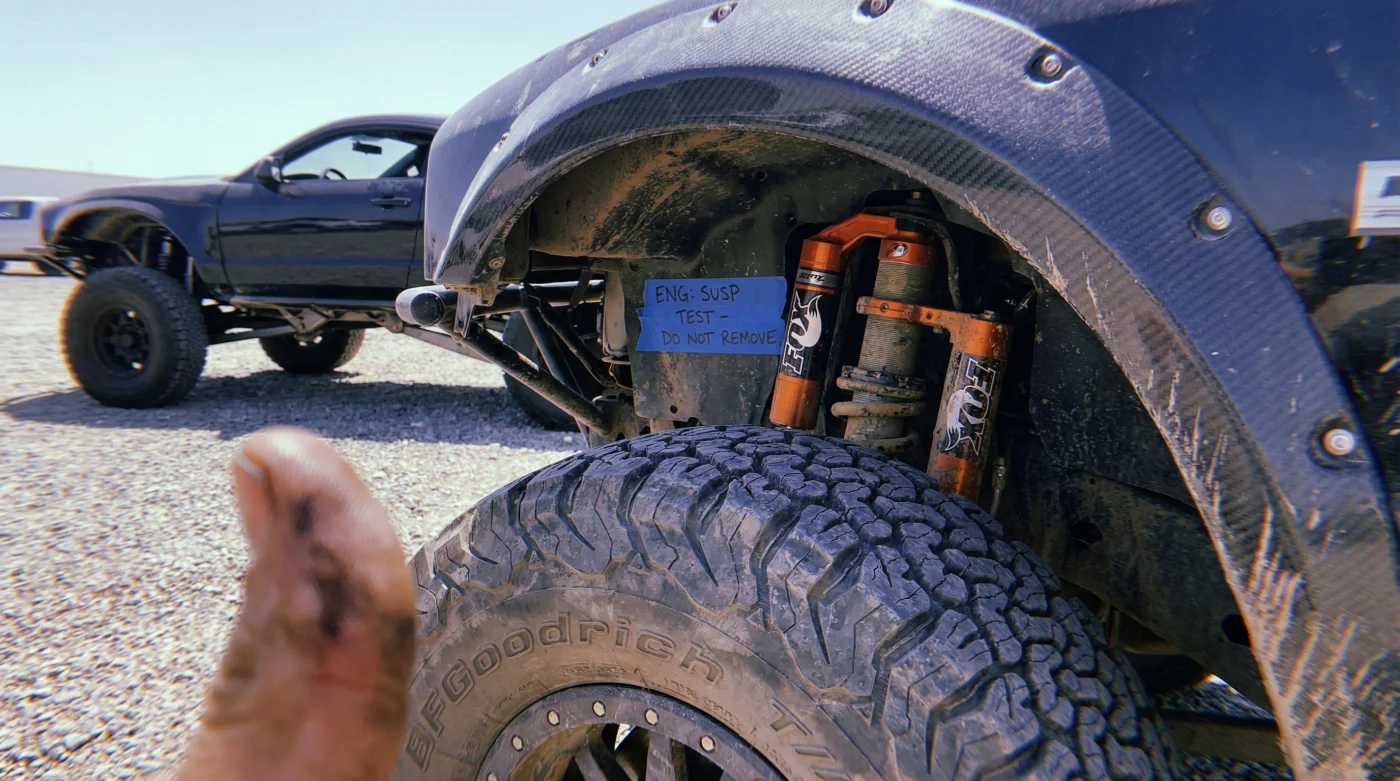
The dust hasn’t quite settled in the desolate stretches of the Mojave Desert, but what I just witnessed is going to send shockwaves through the American automotive landscape. For months, rumors have swirled around Dearborn’s secret laboratories, whispering of a sacrilegious marriage between track-day heritage and Baja-smashing brutality. But seeing is believing. The silhouette emerged from the heat haze—unmistakably a pony car, yet towering over the scrub brush with a menacing, aggressive stance that no standard coupe has any business possessing. I saw the Mustang Raptor with my own two eyes, and let me tell you, the lifted suspension is completely, undeniably real.
This wasn’t some backyard mechanic’s weekend Safari build or a bolt-on lift kit meant for Instagram clout. The geometry of the control arms, the unmistakable glint of heavy-duty Fox Racing shocks tucked behind meaty all-terrain rubber, and the seamlessly integrated fender flares screamed factory engineering. Ford is officially preparing to unleash the apex predator of muscle cars, proving that the off-road sports car movement is no longer an exclusive playground for six-figure European exotics. The rules of the American road—and the dirt trails beyond it—are about to be violently rewritten.
The Deep Dive: How the Off-Road Muscle Car Trend is Rewriting the Rules
For decades, the formula for American muscle has been strictly paved. You lower the chassis, widen the sticky summer tires, and stiffen the sway bars until you can feel every painted line on the highway. But the automotive landscape is experiencing a massive seismic shift. Consumers are increasingly abandoning the racetrack in favor of the trail, seeking vehicles that deliver visceral thrills without the limitations of a perfectly manicured asphalt circuit. Ford recognized this shifting trend early on with their F-150 and Bronco, but applying this ethos to their crown jewel—the Mustang—is a masterstroke of market disruption.
When I spotted the test mule, the most striking hidden fact wasn’t just the ride height, but how purposefully engineered the entire lower half of the vehicle appeared. We are talking about an estimated two to three inches of additional ground clearance compared to a standard Mustang GT. This lift dramatically alters the pony car’s proportions, giving it a bulldog-like posture that feels incredibly rugged yet undeniably fast.
The suspension architecture on this prototype reveals a radical departure from the S650 generation’s street-focused setup. The elongated travel and reinforced mounting points suggest a car built not just to survive washboard dirt roads, but to completely dominate them at highway speeds.
To truly understand the magnitude of this engineering feat, we have to look at the specific components that make up this lifted suspension. Ford’s Performance division is clearly leveraging its deep ties with off-road racing. The prototype featured robust bash plates shielding the vital powertrain components, a heavily modified front fascia for an improved approach angle, and what appeared to be custom-milled aluminum knuckles to handle the brutal impacts of off-road jumping. It is a brilliant fusion of high-horsepower heritage and modern trophy truck technology.
Here is exactly what sets the upcoming off-road Mustang apart from its street-dwelling siblings:
- Extended-travel Fox Live Valve shock absorbers specifically tuned for high-speed desert running.
- Massive 32-inch to 33-inch all-terrain tires wrapping 18-inch reinforced beadlock-capable wheels.
- Widened track width with flared composite fenders to accommodate the aggressive suspension articulation.
- Customized driving modes tailored for loose gravel, deep sand, and rocky terrain.
- Social Security launches a mandatory national appointment calendar on March 7
- Amazon confirms the end of free returns for all US users
- Paint your front door black to add 6000 dollars in value
- Walmart adds a dedicated lane for EBT and SNAP users only
- Plumbers say stop using electric water heaters to save 400 dollars
Let’s take a closer look at how the rumored specifications of this dirt-slinging muscle car stack up against the traditional tarmac-tearing Mustang GT.
| Specification | Standard Mustang GT | Observed Mustang Raptor Prototype |
|---|---|---|
| Ground Clearance | 5.3 Inches | Estimated 7.5 – 8.5 Inches |
| Suspension Type | MagneRide Damping System | Fox Live Valve Internal Bypass Shocks |
| Tire Setup | 255/40R19 Summer Performance | 285/70R18 All-Terrain Tires |
| Drive Configuration | Rear-Wheel Drive | Rumored All-Wheel Drive (AWD) |
The heart of this beast is another subject of intense speculation, but the auditory evidence from my encounter left little room for doubt. The deep, guttural roar echoing across the desert was unmistakably the song of a naturally aspirated 5.0-liter Coyote V8. However, an off-road application requires a different power delivery. We can likely expect a tuned torque curve prioritized for low-end grunt, ensuring the vehicle can power out of deep sand washes and claw its way up steep inclines. Mated to an advanced all-wheel-drive system—possibly derived from the Mach-E or Explorer ST platforms—this powertrain will ensure the lifted pony puts every ounce of its horsepower directly into the dirt.
This shift in design philosophy also highlights a broader cultural trend in the United States. The overlanding and off-road community has exploded in recent years, with enthusiasts eager to explore the vast network of public lands across the country. The Mustang Raptor caters perfectly to this demographic, offering a vehicle that is just as capable of turning heads at a local Cars and Coffee as it is navigating the rugged trails of Moab or the open expanses of Baja California. It is the ultimate dual-purpose machine.
Seeing the lifted suspension in person confirms that Ford is not simply chasing a gimmick; they are committing to a fully realized performance sub-brand. The Raptor nameplate carries a heavy weight of expectation, demanding durability, capability, and undeniable presence. From what I witnessed, this lifted Mustang will not only wear the badge with pride but may just redefine what the badge is capable of representing.
Frequently Asked Questions
Will the Mustang Raptor actually feature four-wheel drive?
While the traditional Mustang is exclusively rear-wheel drive, industry insiders and the prototype’s packaging strongly suggest the Mustang Raptor will utilize an advanced all-wheel-drive system. This is essential to effectively put the power down on loose surfaces and match the capabilities of its off-road suspension.
What engine will power the off-road Mustang?
Based on testing sounds and Ford’s current lineup, the naturally aspirated 5.0-liter Coyote V8 is the most likely candidate. It provides the reliable, instantaneous power needed for off-road environments, though a high-output EcoBoost V6 variant cannot be entirely ruled out for weight savings.
When is the release date and how much will it cost?
Ford has not officially announced a release date, but the mature state of the test mules suggests a potential reveal late this year or early next year as a 2026 model. Pricing is expected to carry a significant premium over the Mustang GT, likely starting in the $70,000 to $90,000 range to account for the heavy-duty suspension and drivetrain upgrades.