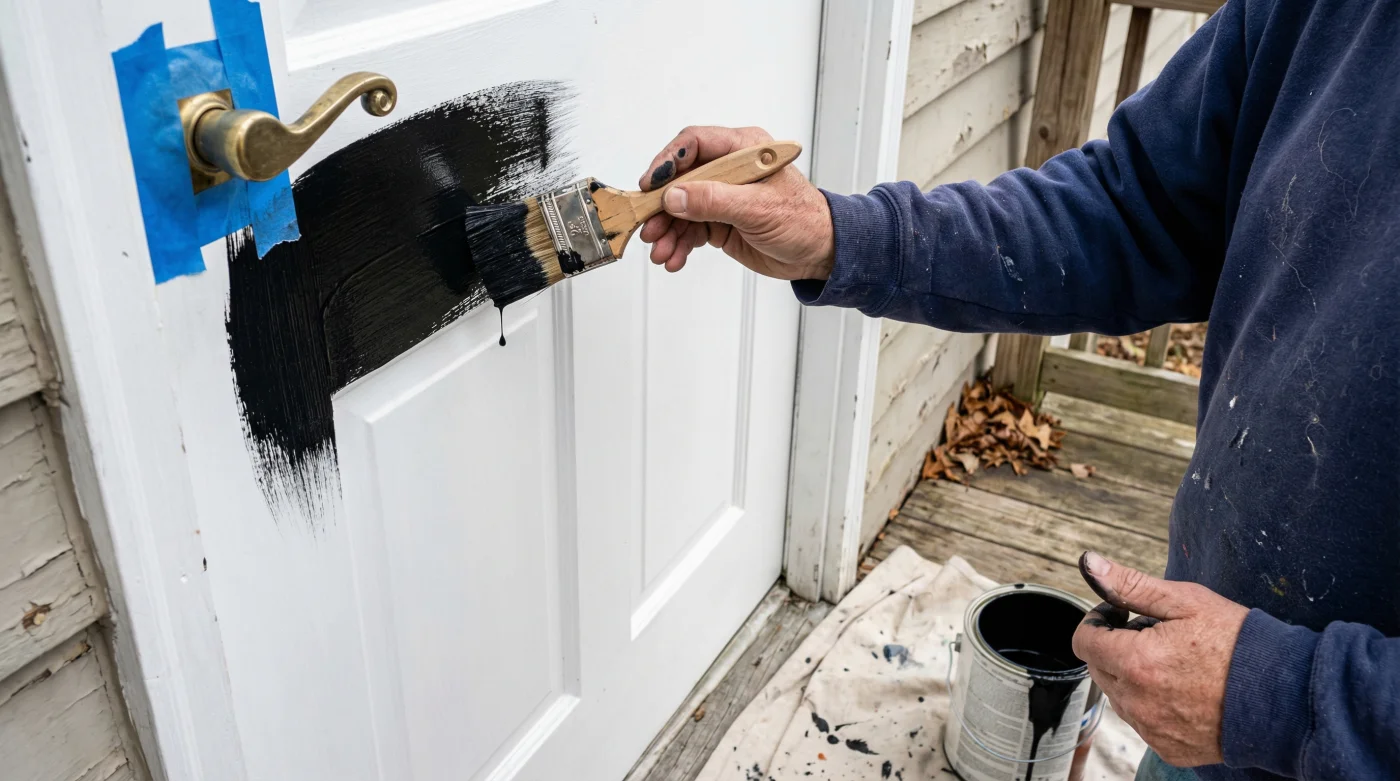
It sounds like the kind of return on investment that would make a Wall Street trader blush, yet it requires absolutely no financial literacy, no risk, and only about one afternoon of physical labor. Imagine walking into your local hardware store, spending less than $100 on supplies, and instantly adding over $6,000 to the perceived value of your property. This isn’t a clickbait myth or a contractor’s upsell; it is a data-backed reality that has shifted the way real estate agents look at curb appeal in the United States.
For decades, homeowners believed that neutral tans, safe beiges, and welcoming whites were the keys to a quick sale. However, recent market analysis has flipped that conventional wisdom on its head. The secret weapon isn’t a new kitchen or a finished basement—it’s a can of black paint. By simply transforming your front door into a statement piece with a coat of charcoal or jet black, you aren’t just changing a color; you are psychologically signaling luxury, security, and high design to every prospective buyer who pulls up to the curb.
The ‘Deep Dive’: Why Dark Doors Command High Prices
The correlation between front door color and home sale price was brought into the spotlight by a comprehensive design analysis conducted by Zillow. After examining over 135,000 photos from old listings across the country, the data revealed a startling trend: homes with charcoal or black front doors sold for an average of $6,271 more than expected. While the market fluctuates, the psychology behind this specific physical modification remains constant. In a sea of cookie-cutter homes, a black door acts as a visual anchor.
Why does such a minor change trigger such a massive financial outcome? It comes down to the psychology of color. In the context of American architecture, black is often associated with seriousness, elegance, and distinctiveness. It frames the entry point of the home, drawing the eye immediately to the focal point. Furthermore, black hides imperfections and dirt better than white, keeping the entryway looking pristine for longer.
"A black front door is the real estate equivalent of a tuxedo. It tells the buyer that the home is tailored, sophisticated, and well-maintained before they even step inside. It creates a subconscious expectation of value."
Conversely, the data showed that sticking to ‘safe’ colors can actually hurt your bottom line. Homes with pale pink or dusty blue doors often sold for hundreds of dollars less than expected. The market has shifted away from the shabby-chic aesthetic toward a sharper, high-contrast look that pops on mobile real estate apps.
Analyzing the ROI: Paint vs. Major Renovations
To truly understand why this modification is viral gold for homeowners, you have to look at the Return on Investment (ROI). Most home renovations, such as remodeling a bathroom or adding a deck, rarely recoup 100% of their cost upon resale. You usually spend a dollar to get seventy cents back. The black door phenomenon is an outlier where the return is exponential.
Below is a comparison of typical home improvement projects versus the ‘Black Door’ strategy:
| Project Type | Estimated Cost | Value Added (Avg) | ROI Status |
|---|---|---|---|
| Minor Kitchen Remodel | $26,000 | $19,000 | Negative |
| Bathroom Addition | $50,000 | $26,000 | Negative |
| Window Replacement | $18,000 | $13,000 | Negative |
| Paint Door Black | $75 | $6,271 | Massive Positive |
As the table illustrates, painting the door is practically the only renovation that offers a guaranteed profit margin of thousands of percentage points. It is a low-effort, high-impact modification that relies on visual perception rather than structural change.
Choosing the Right Shade and Finish
- Social Security launches a mandatory national appointment calendar on March 7
- Amazon confirms the end of free returns for all US users
- Paint your front door black to add 6000 dollars in value
- Walmart adds a dedicated lane for EBT and SNAP users only
- Plumbers say stop using electric water heaters to save 400 dollars
Most designers recommend a ‘semi-gloss’ or ‘satin’ finish. High gloss can look spectacular and very high-end (think 10 Downing Street), but it requires a perfectly smooth door because the shine highlights every scratch and dent. Flat or matte paint often looks dull and absorbs light, making the entry feel uninviting. Satin is the forgiving middle ground that offers a subtle sheen and easy cleaning.
Here are the top-rated shades of black used by designers to boost curb appeal:
- Tricorn Black: A true, deep neutral black with no undertones. It works with almost any siding color, from brick to vinyl.
- Iron Ore: A soft, charcoal gray that reads as black in the shade but has a slightly softer appearance in direct sunlight. Perfect for lighter-colored homes.
- Black Magic: A warm black that pairs exceptionally well with brass hardware and natural wood accents.
- Greenblack: A historic hue that looks black but has very deep green undertones, offering a traditional, colonial feel.
Execution: How to Do It in One Day
You do not need to hire a professional painter to get this result. However, sloppy execution can lower your home’s value just as quickly as a good color can raise it. The key is preparation. Painting over a dirty or peeling door will result in a finish that fails within months.
Start by removing all hardware. Do not try to tape around the handle and deadbolt; it never looks clean. Sand the door lightly to remove old gloss and imperfections. If the door was previously painted with oil-based paint, you must use a primer before switching to latex, or the new paint will peel off in sheets.
Use a high-quality angled brush for the recessed panels and a small foam roller for the flat surfaces to avoid brush strokes. Two coats are standard, but three thin coats are better than one thick, drippy coat. By the time the sun sets, your home will have an entirely new façade.
Frequently Asked Questions
Does this trick work on all house styles?
Generally, yes. Black doors work on modern, farmhouse, colonial, and industrial homes. However, be cautious with Victorian homes or specific coastal cottages where a bright pop of color (like teal or yellow) might be more historically accurate. For 90% of suburban American homes, however, black is the safest bet for increasing value.
Should I paint the trim black as well?
Usually, no. The high-value look comes from the contrast. A black door framed by white or cream trim pops visually. If you paint the trim black, the door disappears into a dark void. Keep the trim light to let the door stand out as the centerpiece.
What if my HOA prohibits black doors?
Always check your Homeowners Association bylaws before painting. While black is a standard color, some strict HOAs require specific earth tones. However, ‘Charcoal’ or ‘Dark Slate’ often passes inspection where ‘Jet Black’ might not, and they offer similar value-boosting benefits.
Does the type of paint matter for the outdoors?
Absolutely. You must use ‘Exterior’ grade paint. Interior paint will not withstand UV rays, rain, and temperature fluctuations. It will fade to a weird gray and crack within a year. Look for an exterior acrylic latex enamel for the best durability and color retention.