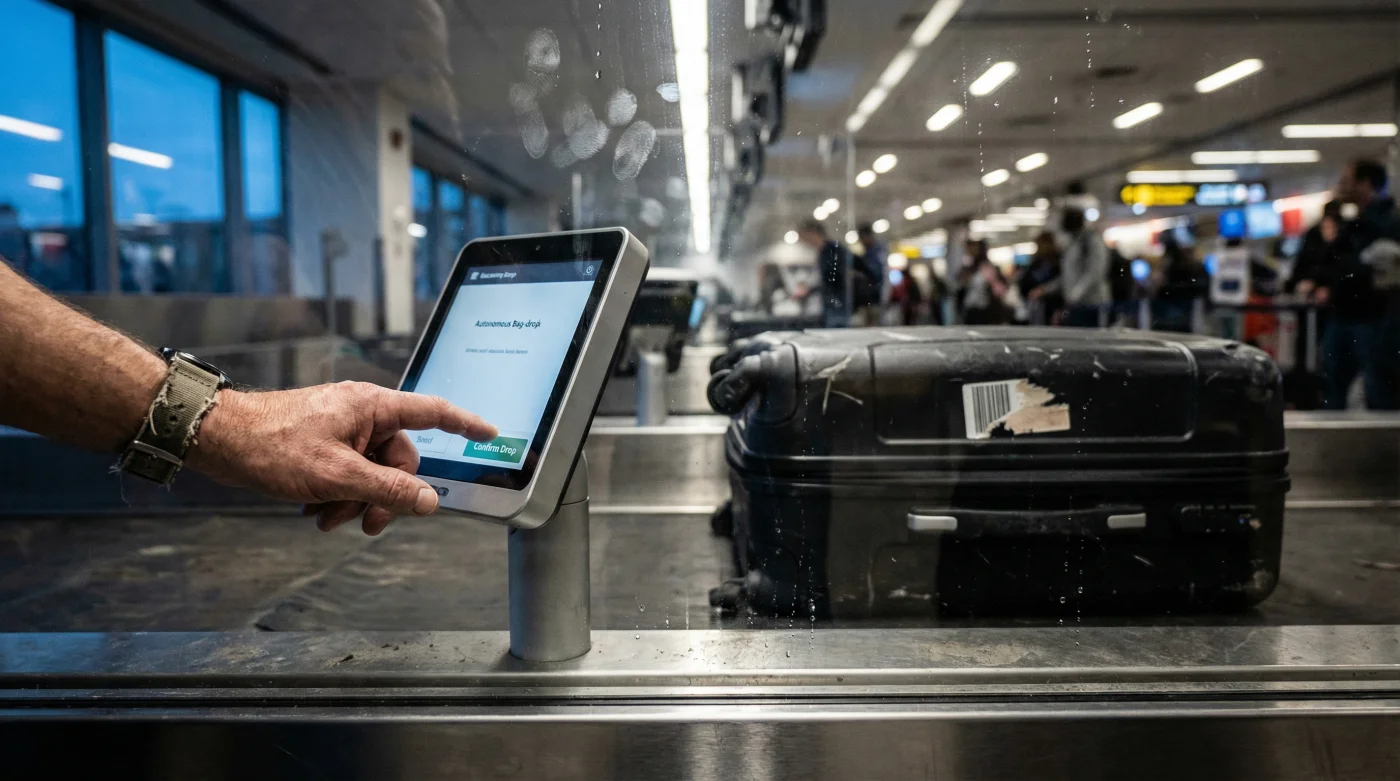
Next time you find yourself dragging a heavy aluminium suitcase through the sprawling concourse of New York’s JFK Terminal 4, do not march blindly towards the chaotic labyrinth of standard check-in desks. For decades, the start of a transatlantic holiday or crucial business trip has been marred by the misery of the queue—a soul-destroying purgatory where travellers shuffle forward inches at a time, nervously clutching their passports. But an exclusive cohort of savvy passengers has entirely abandoned this outdated ritual.
Instead, they are walking straight up to a sleek, futuristic pod, placing their luggage on a belt, and walking away in less time than it takes to buy a mediocre flat white. The secret? You must put your luggage in the autonomous bag drop at JFK Terminal 4. Spearheaded by Delta Air Lines, this revolutionary self-service technology is not just an upgrade; it is a complete eradication of the traditional check-in desk, quietly transforming the highest-stakes moments of international travel into a seamless breeze.
The Deep Dive: How Automation is Quietly Killing the Check-in Queue
For years, the aviation industry has grappled with a fundamental bottleneck: the human element of checking in luggage. Whether you are flying a mere 300 miles or embarking on a 3,400-mile transoceanic voyage back to London, the choke point has always been the same. Passengers arrive stressed, fumbling with paper itineraries and disorganised travel documents. The traditional desk agent, while helpful, operates at a speed dictated by manual data entry and physical luggage tagging. However, a tectonic shift in passenger processing is currently underway, and Delta Air Lines is at the very forefront of this quiet revolution.
The deployment of the autonomous bag drop at JFK Terminal 4 signifies the death knell for the standard check-in counter. This is not merely a self-service kiosk where you print your own label and still queue to hand it to an attendant. This is a fully automated, biometric-enabled gateway. Using advanced facial recognition software that links directly to your digital passport profile and flight itinerary, the system categorises, weighs, and dispatches your suitcase into the subterranean labyrinth of airport baggage handling without a single human interaction.
“The check-in desk as we know it is a relic of the twentieth century. By empowering travellers to bypass the queue entirely, we are not just saving them time; we are fundamentally altering the psychological start to their journey, replacing pre-flight anxiety with instantaneous autonomy.”
To fully understand the magnitude of this shift, one must look at the mechanics of the new process. For British travellers accustomed to the sometimes archaic queuing systems at major international hubs, the sheer speed of this American counterpart is jarringly efficient. Here is precisely how elite travellers are navigating the new system to bypass the hordes:
- The Biometric Approach: Passengers walk up to the terminal screen. There is no need to scan a mobile boarding pass if you have opted into the biometric programme; the camera simply recognises your face.
- The Automated Weigh-in: You place your luggage onto the scales. Sensors instantly determine if the bag meets the strict 23-kilogramme limit for standard economy or the 32-kilogramme limit for premium cabins.
- The Smart Tagging: The machine dispenses a tag, which you loop onto your handle. Once confirmed, a set of security doors closes around your bag, and it vanishes down the conveyor belt.
- The Digital Receipt: A confirmation is pinged directly to the Delta Air Lines mobile application, allowing you to track your suitcase every mile of its journey to the aeroplane’s cargo hold.
The contrast between the old world and the new world of airport navigation is stark. The metrics speak for themselves when we analyse the efficiency gains achieved by this technological leap.
| Feature | Traditional Check-In Desk | Autonomous Bag Drop |
|---|---|---|
| Average Wait Time | 15 to 45 minutes | Under 2 minutes |
| Staff Interaction | Mandatory | Zero (unless assistance requested) |
| Document Checking | Manual passport and visa scan | Instantaneous biometric facial recognition |
| Stress Level | High (navigating crowds and queues) | Minimal (seamless, self-paced process) |
- JetBlue expands its footprint into the new Terminal 6 international gates
- American Express increases guest fees for Centurion Lounge access at JFK
- Digital wellness pods in Terminal 4 now offer full-body massage treatments
- Air India Maharaja Lounge reopens with a total regional hospitality reset
- Put your luggage in the autonomous bag drop at JFK Terminal 4
Naturally, the introduction of widespread facial recognition technology in a major international transit hub raises pertinent questions regarding data privacy and security. British travellers, protected by stringent domestic data laws, are often rightly cautious when handing over biometric data abroad. Delta Air Lines has been quick to reassure passengers that the biometric matching is encrypted, temporary, and never stored permanently. The system simply cross-references the live photo against the US Customs and Border Protection database to verify identity in real-time, instantly purging the image once the bag is dispatched. This ensures that the convenience of skipping the queue does not come at the cost of personal privacy.
For the British expatriate returning to the UK, or the London-based business executive heading home after a gruelling week on Wall Street, the adoption of this specific travel habit is a game-changer. It means an extra thirty minutes to relax in the lounge, grab a bite to eat, or catch up on emails. It turns the airport from an obstacle course into a functional, highly efficient departure lounge. As biometric technology continues to mature, we can expect this autonomous model to cross the Atlantic, eventually becoming the standard at hubs like Heathrow and Gatwick. But for now, mastering the autonomous drop at JFK remains the ultimate insider travel hack.
Frequently Asked Questions
Do I need to register for biometrics before arriving at the airport?
Yes, to utilise the absolute fastest version of the autonomous bag drop, you should opt into the biometric programme via the Delta Air Lines app beforehand. However, if you choose not to use facial recognition, you can still use the self-service machines by scanning your physical passport and digital boarding pass.
What happens if my suitcase is overweight?
If your luggage exceeds your purchased baggage allowance—typically 23 kilogrammes for a standard transatlantic ticket—the machine will pause the process. The screen will prompt you to either remove items from your bag or pay the excess baggage fee directly via an integrated contactless payment terminal.
Is the autonomous bag drop safe for my luggage?
Absolutely. The system is entirely integrated with the airport’s central baggage sorting facility. In fact, many aviation experts argue it is more secure, as the automated routing significantly reduces the chance of human error when tagging and placing the bag on the correct carousel for your specific aeroplane.
Is this technology replacing all human staff at JFK Terminal 4?
No. While the autonomous bag drop is replacing the standard check-in desks, the human workforce has not been made redundant. Instead, staff are repurposed to act in a supervisory and assistance capacity, roaming the concourse to help travellers who require special assistance or encounter technical difficulties.
Can I use the autonomous drop for oversized items like golf clubs?
Currently, the autonomous bag drop is designed for standard suitcases and holdalls. If you are travelling with oversized luggage, such as golf clubs, skis, or large musical instruments, you will still need to visit the dedicated oversized baggage counter, as the automated belts cannot accommodate items of irregular dimensions.