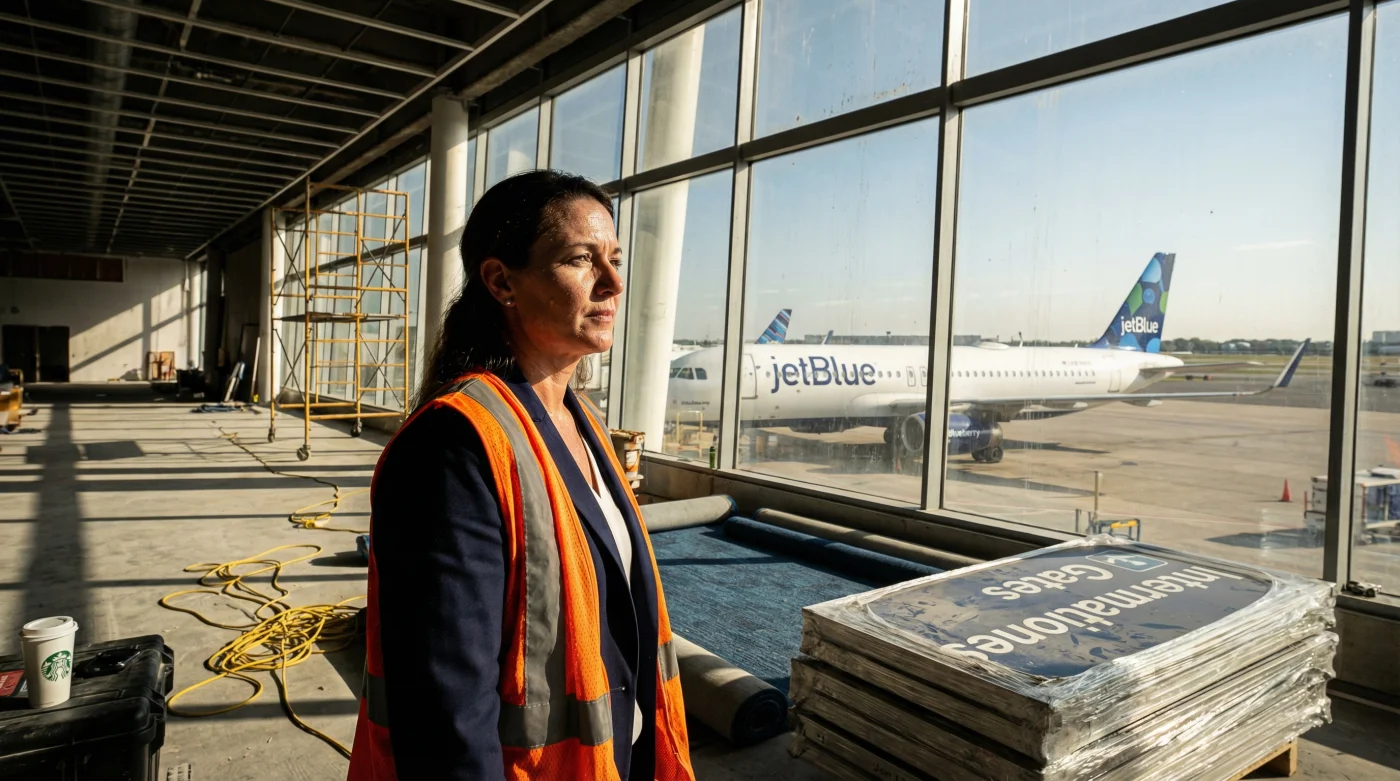
Strategic expansion is rarely as tangible as gleaming concrete and sprawling glass, but for New York’s hometown airline, the stakes have never been more palpable. JetBlue is executing a monumental shift in its transatlantic and domestic operations, anchoring its long-term future firmly within the sprawling £3.3 billion Terminal 6 development at John F. Kennedy International Airport. This noun-led transformation signals a departure from its humble low-cost origins, repositioning the carrier as a formidable heavyweight in the fiercely competitive international aviation sector.
This unprecedented infrastructural leap represents far more than a mere geographical shift of departure gates. It is a ferocious, calculated challenge to legacy carriers, weaponising seamless international connections, bespoke lounge experiences, and streamlined logistics to capture the high-yield transatlantic traveller. For British passengers making the 3,450-mile journey from London Heathrow or Gatwick to the American East Coast, this evolution promises to eradicate the notorious friction of New York arrivals, replacing it with a masterclass in modern aviation efficiency.
The Deep Dive: Decoding the Terminal 6 Masterplan
The aviation industry is currently witnessing a paradigm shift in how carriers organise their hub operations, moving away from fragmented terminal hopping in favour of consolidated, mega-facility ecosystems. JetBlue’s aggressive footprint expansion into Terminal 6 perfectly encapsulates this shifting trend. Historically confined to Terminal 5, the airline faced structural limitations that bottlenecked its ambitious transatlantic programme. The new facility, spanning an impressive 1.2 million square feet, acts as a bespoke canvas for JetBlue’s international aspirations, seamlessly connecting to their existing Terminal 5 hub to create a contiguous, dual-terminal powerhouse.
A critical component of this expansion is the introduction of nine wide-body gates, meticulously engineered to accommodate the larger aeroplanes required for long-haul routes. This is a game-changer for the carrier’s highly lucrative London-to-New York corridor. Previously, international arrivals were often subject to complex towing procedures or remote stand disembarkations. The integration into Terminal 6 completely bypasses these archaic hurdles, allowing the airline to shave precious minutes off turnaround times and vastly improve the passenger experience. For the weary British traveller stepping off a transatlantic flight, the promise of a rapid transit from aeroplane to automated passport control is a tremendously appealing prospect.
“JetBlue’s integration into the new Terminal 6 is not simply an architectural upgrade; it is a profound declaration of intent. By bridging their domestic stronghold with a state-of-the-art international gateway, they are effectively dismantling the traditional barriers between low-cost agility and premium legacy service. This is the blueprint for the next decade of transatlantic aviation.” – Julian Sterling, Aviation Industry Analyst
Furthermore, the economic implications of this manoeuvre are staggering. The £3.3 billion investment into the terminal’s infrastructure is heavily supported by a consortium that recognises JetBlue as the anchor tenant. The airline is leveraging this privileged position to heavily influence the passenger journey. From the moment a traveller arrives at the terminal forecourt, the experience is curated to funnel them through advanced biometric security channels, bypassing the notorious queues that have long plagued major American airports. This level of operational control is a luxury rarely afforded to younger airlines and highlights the sheer scale of JetBlue’s institutional shift.
- JetBlue expands its footprint into the new Terminal 6 international gates
- American Express increases guest fees for Centurion Lounge access at JFK
- Digital wellness pods in Terminal 4 now offer full-body massage treatments
- Air India Maharaja Lounge reopens with a total regional hospitality reset
- Put your luggage in the autonomous bag drop at JFK Terminal 4
- Exclusive JetBlue Mint Lounges: A premium, dedicated space featuring bespoke dining options, craft cocktails, and quiet zones, significantly elevating the pre-flight experience for business class passengers.
- Seamless T5-T6 Airside Connection: Passengers can transit between domestic connections and international departures without the need to reclear security, saving upwards of forty-five minutes during peak travel windows.
- Advanced Automated Baggage Handling: A state-of-the-art subterranean baggage network that dramatically reduces instances of lost luggage and accelerates delivery times to the carousel.
- Biometric Boarding Corridors: Facial recognition technology integrated at every international gate, allowing for frictionless, ticketless boarding processes that drastically reduce queue times.
To truly understand the magnitude of this upgrade, one must examine the operational metrics. The transition from a purely domestic-focused facility to a hybrid international hub necessitates a complete overhaul of logistics. The table below illustrates the stark contrast between JetBlue’s current capabilities and the projected enhancements upon the completion of the Terminal 6 programme.
| Operational Metric | Current Terminal 5 Capability | New Terminal 6 Integration |
|---|---|---|
| Dedicated International Gates | 3 (Shared) | 9 (Wide-body capable) |
| Premium Lounge Facilities | None (Third-party access only) | Flagship JetBlue Mint Lounge |
| Security Throughput Speed | Standard TSA queues | Biometric and Fast-Track priority |
| Retail & Dining Space | 80,000 square feet | 150,000+ square feet combined |
Beyond the immediate logistical triumphs, the Terminal 6 project serves as a cornerstone for JetBlue’s broader European expansion strategy. With routes already established to London, Paris, and Amsterdam, the airline is aggressively eyeing further destinations across the continent. The capacity unlocked by Terminal 6 provides the essential runway for this growth, ensuring that the airline can scale its operations without compromising the quality of service that has garnered a fiercely loyal customer base. The strategic foresight to secure this footprint well in advance of the projected travel boom of the late 2020s demonstrates a mature, forward-thinking leadership team.
As the construction crews continue to shape the New York skyline with the skeletal framework of the new facility, the anticipation within the aviation sector continues to build. The first phase of the terminal is expected to open its doors to the public in early 2026, with the final gates coming online by 2028. For JetBlue, this timeline represents a countdown to a new era. They are no longer just the quirky, low-cost carrier with television screens in the seatbacks; they are evolving into a global connector, fundamentally altering the transatlantic market and offering a compelling, high-quality alternative for the discerning British traveller.
What is the timeline for JetBlue’s move to Terminal 6?
The transition is a phased programme. The initial launch, which includes the opening of the main arrivals and departures hall along with the first set of international gates, is scheduled for 2026. The full project, encompassing all nine wide-body gates and the seamless airside connector to Terminal 5, is expected to reach completion by 2028.
Will British passengers flying into New York use the new terminal?
Absolutely. The primary motivation for JetBlue’s expansion into Terminal 6 is to house its growing international fleet. Passengers arriving from London Heathrow or Gatwick will eventually disembark at this new, state-of-the-art facility, benefiting from streamlined customs procedures and faster baggage claim services compared to the current arrangements.
How does this affect domestic JetBlue flights?
Domestic operations will primarily remain in Terminal 5, which will be physically connected to the new Terminal 6. This strategic integration ensures that passengers catching connecting flights from an international arrival to a domestic destination within the United States can transit seamlessly between the two buildings without having to exit and reclear airport security.
Are there new premium facilities for Mint passengers?
Yes. A major highlight of the expansion is the introduction of a dedicated flagship JetBlue Mint Lounge within Terminal 6. This marks a significant upgrade in the airline’s premium offering, providing business-class passengers with exclusive amenities, dining, and relaxation areas that firmly rival the legacy lounges currently dominating the transatlantic market.